Reviewing the Let’s Eat Healthily SVG for Real Embroidery
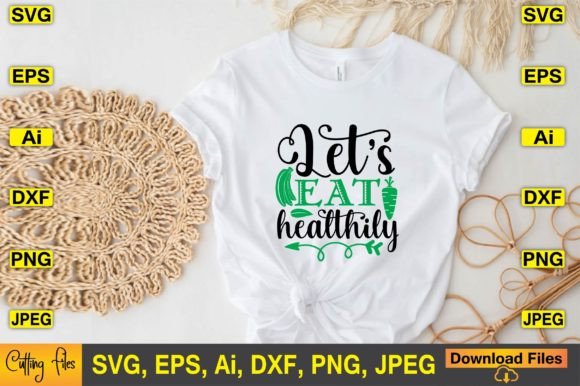
As a designer who spends half my life digitizing and the other half stitching, I have learned to look past the glossy mockups. We all know that what looks crisp on a computer screen does not always translate cleanly to fabric. When I first pulled up the Let’s Eat Healthily SVG T-shirt Print, my initial reaction was cautious optimism. The phrase itself carries a playful, modern energy that fits perfectly into the current wellness and lifestyle trends. However, as an embroidery product reviewer, my job is to determine if this graphic holds up under the needle, not just the printer.
This piece is marketed primarily as a vegan SVG digital download for cutting machines like Cricut and Silhouette. It is categorized under T-Shirt Designs and Graphics. But for those of us in the craft business, the line between a cut file and an embroidery design is often blurred by creativity. I wanted to see if this specific layout could transition from a vinyl heat press project to a stitched embroidery project without losing its charm or becoming a technical nightmare.
First Impressions: Mood and Visual Personality
The design exudes a casual, approachable vibe. It is not overly ornate, which is a blessing for embroidery. Complex, dense illustrations often result in puckered fabric and broken needles. The Let’s Eat Healthily SVG T-shirt Print relies on clean lines and bold typography. This simplicity suggests that it would work well with basic stitch types. I envision using a combination of satin stitch for the borders or smaller text elements and a light fill stitch for any accompanying icons, such as fruits or vegetables, if included in the specific variation of the file.
The mood is cheerful and inviting. It feels right for a kitchen setting or casual wear. When I imagine this stitched onto a canvas tote bag design, it creates an instant narrative about healthy living and eco-conscious choices. For an Etsy seller or small shop owner, this thematic consistency is gold. It appeals to a specific demographic—those who value sustainability and health—making it easier to market as a cohesive handmade product.
Real-World Application: From Screen to Stitch
I decided to test the concept mentally against a real-life scenario: creating a custom gift for a friend who recently started a meal-prep service. She needed branded aprons and tote bags. While the file is described as a cutting file, the shapes are distinct enough to be manually digitized or used as a template for applique. If you are working with a pre-digitized embroidery file version of this design, the clarity of the shapes is crucial.
For custom apparel, such as a cotton sweatshirt, this design would sit comfortably on the chest or the lower left hem. The spacing in the typography appears generous, which reduces the risk of thread bunching. In sweatshirt embroidery, where the fabric is thicker and has more pile, open designs perform better than dense blocks of color. This design seems to respect that balance. It allows the texture of the garment to breathe, ensuring the stitching remains legible and attractive.
If you are considering this for baby embroidery items, such as a bib or a onesie, scale is everything. The playful nature of the message fits the innocence of childhood, but you must ensure the text remains large enough to be read clearly. Tiny details get lost in the wash, and parents need durability. A simplified version of this graphic, perhaps using only the main text with a minimal icon, would make a delightful personalized gift that stands up to frequent laundering.
Technical Considerations and Fabric Choices
Here is where practical judgment comes into play. Since the source material is a vector SVG intended for cutting, converting it to stitches requires attention to stitch density. If you are digitizing this yourself, avoid making the letters too thick. Thick satin columns can snag and look bulky. Instead, consider using a running stitch for internal details or opting for an applique design approach where the fabric provides the color and the machine merely stitches the outline.
Fabric texture plays a massive role in the final outcome. On smooth cotton or linen, the Let’s Eat Healthily SVG T-shirt Print will look sharp and professional. However, on textured fabrics like terry cloth towels or fuzzy fleece, you may lose definition. In these cases, increasing the contrast between the thread colors and the background fabric is essential. Dark threads on light fabric, or vice versa, will help the design pop.
Be cautious with stretchy fabrics. If you plan to put this on a yoga top or a fitted tee, you must use a high-quality cut-away stabilizer. Without proper support, the tension of the stitches will distort the fabric, causing the design to pucker and the text to warp. Always test on scrap fabric first. This is non-negotiable for professional results. Check how the design behaves in both horizontal and vertical orientations, especially if placing it on curved surfaces like caps or sleeves.
Commercial Viability for Craft Businesses
For commercial embroidery and small business owners, versatility is key. This design fits neatly into several product categories. It works for holiday embroidery gifts, particularly for New Year’s resolutions centered on health. It is suitable for embroidered patch creation, which can then be ironed or sewn onto jackets and bags, adding value through modularity. Patches are a trending item in boutique branding, allowing customers to customize their own gear.
When listing this as part of your small shop product lineup, consider the perceived value. Embroidery generally commands a higher price point than vinyl printing because of the time and skill involved. By offering this design as a stitched element rather than a printed one, you elevate the finished product. It feels more luxurious and durable. Customers associate embroidery with longevity and quality, which builds trust and encourages repeat business.
However, always verify the licensing terms. The description mentions it is a digital download for cutting files. If you are using it to create physical goods for sale, ensure you have the commercial rights for the underlying artwork. If you are digitizing it yourself, you are creating a new derivative work, but the original graphic’s license still applies. Clarity here protects your craft business from legal issues down the line.
Final Designer Notes
Before you commit to a full production run, take these steps:
- Test on multiple fabrics: See how the design interacts with denim, cotton, and blends.
- Check hoop size compatibility: Ensure the design fits within your standard hoops without requiring excessive re-hooping.
- Evaluate thread contrast: Use a printable mockup or physical thread swatches to confirm readability.
- Review stitch paths: If digitizing, minimize jumps and trims to speed up production time.
- Consider the audience: Does this resonate with your specific customer base? For men, women, and kids, the universal appeal of health is strong, but the styling should match their aesthetic.
In conclusion, the Let’s Eat Healthily SVG T-shirt Print offers a solid foundation for creative adaptation. While it originates as a graphic for cutting machines, its clean structure makes it a viable candidate for embroidery when handled with care. It brings a fresh, positive energy to T-Shirt Designs and home goods alike. For the experienced maker, it is not just a file; it is an opportunity to create meaningful, tactile products that people love to use and wear. Just remember to respect the technical limits of your machine and fabric, and you will produce work that stands out in a crowded market.